Designing
human-computer interfaces is still an art,
learned best by creating many interfaces and
carefully observing how real users interact with
them. However, there are many tools from
cognitive psychology that, if understood and
applied, can yield at least two benefits. First,
by learning what is known about how humans
operate, you can avoid many pitfalls in design.
Second, you can make quantitative design
decisions.
This book, though nearly 20 years old, contains
much essential material that is unknown to many
practitioners in the field! - Jef Raskin
Reviews the features and
applications of a broad range of computer
software systems that allow the user to choose
the sequence of text or other display at the
time of use.
Explores
the central issues of user interface design,
including the problems presented by multimedia
applications. It is a unique treasury of ideas
and opinions from one of the key thinkers in the
industry. It will be required and fascinating
reading for all those concerned with the
relationship between computers and people.
"Tog's book is a must-read. It's chock-full
of intuitive insights and practical technical
examples. My favorite story is why people walk
into their furniture after going on camping
trips. You'll have to read the book to find out
the reason!" - Roger von Oech, Author.
This
comprehensive introduction to the field
represents the best of the published literature
on groupware and computer-supported cooperative
work (CSCW). The papers were chosen for their
breadth of coverage of the field, their clarity
of expression and presentation, their excellence
in terms of technical innovation or behavioral
insight, their historical significance, and
their utility as sources for further reading.
Taken as a whole, the papers and their
introductions are a complete sourcebook to the
field.
Written by the author of the
best-selling HyperText & HyperMedia, this
book is an excellent guide to the methods of
usability engineering. The book provides the
tools needed to avoid usability surprises and
improve product quality. Step-by-step
information on which method to use at various
stages during the development lifecycle are
included, along with detailed information on how
to run a usability test and the unique issues
relating to international usability.
Cost-Justifying
Usability by
M. Randolph G. Bias (Author), Randolph G. Bias (Editor), Deborah J. Mayhew
(Editor)
1994
Today's
increasingly competitive and fiscally
constrained business environment is fostering
the need to cut costs and justify expenditures.
Usability engineering is not yet universally
accepted, nor is it yet an integrated aspect of
software engineering, and would-be usability
champions need more help than ever to win the
funding necessary to introduce and promote
usability engineering techniques.
Presents
a step-by-step approach to usability testing in
today's fast-paced industrial production
environment, where reducing time to market has
become a prerequisite for survival. Contains
chapter coverage for each of the six stages
including numerous examples and case studies.
Provides information on the politics and human
elements of testing within an organization.
Features plenty of inside tips and tricks to
help ease the testing process.
With
the world continuing to shrink into a
"global village," software companies
are working to make programs that transcend
language and cultural borders. One such way is
through international user interfaces where the
software is prepared so that it can be easily
localized in each country. This book focuses on
user interfaces, exploring what they can do, and
what they need to do to become commercially
viable.
Introducing
a proven user interface design model for the
design and development of high-quality user
interfaces, this new edition is a professional
guide to designing traditional graphical user
interfaces (GUIs) and object- oriented graphical
user interfaces, plus high-quality
character-based interfaces, and state-
of-the-art multimedia user interfaces. Covers
prototyping and usability testing; multimedia
user interfaces, including discussions of sound,
high- resolution images, and full-motion video;
task analysis; the three most popular
statistical methods; and documentation and
training issues. For user interface specialists,
programmers, systems analysts, system designers,
project leaders, and system engineers.
The Elements of
User Interface Design is written by a cognitive
psychologist and interface design specialist
with more than a decade's research and design
experience. Writing for novices and veteran
developers and designers alike, Dr. Mandel takes
you from command-line interfaces and
graphical-user interfaces (GUIs) to
object-oriented user interfaces (OOUIs) and
cutting-edge interface technologies and
techniques. Throughout, coverage is liberally
supplemented with screen shots, real-life case
studies, and vignettes that bring interface
design principles to life.
Task
analysis is an important aspect of user
interface design, insuring that the end product
is usable and practical. Written by task
analysis experts, this book is the first book
that provides full-length coverage of task
analysis. It covers in detail every step of the
task analysis process, and discusses the
methodologies behind it.
Developing User Interfaces is targeted at the
programmer who will actually implement, rather than design, the user interface.
Most user interface books focus on psychology and usability, not programming
techniques. This book recognizes the need for programmers to collaborate with
usability experts and psychologists, so topics such as the principles of
visualization, human perception, and usability evaluation are touched upon. Yet
the primary focus remains on those tools and techniques required for programming
the complex user interface. Focuses on advanced programming topics event
handling interaction with geometric objects widget tool kits input syntax Useful
to programmers using any language-no particular windowing system or tool kit is
presumed, examples are drawn from a variety of commercial systems, and code
examples are presented in pseudo code The basic concepts of traditional computer
graphics such as drawing and three-dimensional modeling are covered for readers
without a computer graphics background.
Top-notch
support for cooperative software activities.
Since CSCW systems are distributed and often
require near real-time response capabilities
over wide area networks, CSCWs must be
fault-tolerant and have the capacity to run in
heterogeneous environments. This book addresses
these challenges, addressing groupware, shared
editing, mediaspaces, coordination and
integrated tools, and formal methods.
This book is about achieving
usability in product user interface design
through a process called Usability Engineering.
Usability Engineering techniques presented
include not only UI requirements analysis,
design and evaluation techniques, but also
organizational and managerial strategies. The
book is organized around a typical project
lifecycle, and presents usability engineering
techniques, which can be applied at different
points in the development process.
One
of the biggest problems facing Web designers is
how to get users to absorb content. Designing
Web Usability: The Practice of Simplicity is a
tutorial and exposition of the principles of
design that help bring the user to the content
in an effective and efficient way. It features
new approaches for crafting effective sites
through logical and strategic presentation. It
aids users in building Web sites that stand out
from the noise of the Internet with clarity and
purpose. Done up in full-colour with practical
examples and critiques, it will make your site
an effective communicator.
The
creation of computer technologies for children
is a multidisciplinary process whose techniques
and functions are growing increasingly
important. This contributed work will discuss
how and why new technologies are being designed,
introduce the diversity of approaches that
university researchers use in their research
methodologies, and explain the range of
technologies being created today for children.
Written in
plain English and filled with examples, the book
begins by defining usability and explaining
methods of usability engineering. Readers are
taken through all the steps for planning and
conducting a usability test, analysing data, and
using the results to improve both products and
processes. Included are forms that can be used
or modified to conduct a usability test, and
layouts of existing labs that will help readers
to build their own.
Conceptual Modeling for
User Interface Development introduces the
technique of Entity-Relationship-Modeling and
shows how the technique can be applied to
interface issues. It explains those aspects of
entity-relationship modeling which are relevant
to ERMIAs, and it presents the extensions to the
notation that are necessary for modeling
interfaces. This book is aimed at both interface
designers and software developers in an attempt
to bridge the gap in the development of
interactive systems. Too often, when software is
being developed, the software engineers do not
sufficiently consider how easy the system will
be to learn and use. On the other side,
interface specialists tend to express their
concerns in ways which are either too detailed
to be readily understood or in ways which are
difficult for the software developer to
implement. ERMIA provides a set of concepts
which can be used equally easily by software
developers and interface designers alike.
Traditional
textbook approaches manage the complexity of the
design process via abstraction, treating design
problems as if they were composites of puzzles.
Scenario-based design uses concretization.
Scenarios are a vocabulary for
coordinating the central tasks of system
development--understanding people's needs,
envisioning new activities and technologies,
designing effective systems and software, and
drawing general lessons from systems as they are
developed and used. Instead of designing
software by listing requirements, functions, and
code modules, the designer focuses first on the
activities that need to be supported and then
allows descriptions of those activities to drive
everything else.
In
Don’t Make Me Think, usability expert Steve
Krug distills his years of experience and
observation into clear, practical and often
amusing common sense advice for the people in
the trenches (the designers, programmers,
writers, editors, and Webmasters), the people
who tell them what to do (project managers,
business planners, and marketing people), and
even the people who sign the checks.
Information appliances
and other interactive products "beyond the
desktop" present user interface design
challenges that are only beginning to be
understood. In this one-of-a-kind book,
interaction designers examine the issues they
confronted in their projects: Microsoft Windows
CE, a vehicle navigation system, interactive
children's toys, and more. You'll enjoy reading
their engaging and sometimes surprising stories,
but more importantly you'll gain insights that
will benefit your own design and development
work.
This
unique guide to interactive system design
reflects the experience and vision of Jef Raskin,
the creator of the Apple Macintosh project.
Other books may show how to use today's widgets
and interface ideas effectively. Raskin,
however, demonstrates that many current
interface paradigms are dead ends, and that to
make computers significantly easier to use
requires new approaches. He explains how to
effect desperately needed changes, offering a
wealth of innovative and specific interface
ideas for software designers, developers, and
product managers.
The
purpose of the book is to set up a framework for
discussions on social and technical issues of
online communities. Designing usability and
supporting sociability lays a solid foundation
on which online communities can grow and thrive.
Intended for both students and computer
professionals, the book addresses the
development of new online communities as well as
the improvement of existing ones. It is divided
into two parts - Getting Acquainted with Online
Communities and Developing Online Communities -
along with a preface and a concluding chapter
which explores the future of online communities.
One
of the key determinants of success for today's
high-technology companies is product
strategy-;and this guide continues to be the
only book on product strategy written
specifically for the 21st century high-tech
industry. More than 250 examples from
technological leaders including IBM, Compaq, and
Apple-;plus a new focus on growth strategies and
on Internet businesses-;define how high-tech
companies can use product strategy and product
platform strategy for competitiveness,
profitability, and growth in the Internet age.
GUI
Bloopers looks at user interface design bloopers
from commercial software, Web sites, and
information appliances, explaining how
intelligent, well-intentioned professionals made
these dreadful mistakes--and how you can avoid
them. While equipping you with all the theory
needed to learn from these examples, GUI expert
Jeff Johnson also presents the reality of
interface design in an entertaining, anecdotal,
and instructive way.
This is an excellent, well-illustrated resource
for anyone whose work touches on usability
issues, including software engineers, Web site
designers, managers of development processes, QA
professionals, and usability professionals.
The
Unfinished Revolution is nothing less than
an inspired manifesto for the future of
computing. Dertouzos's vision will change how
businesses, organizations, and governments work
with each other, and how individuals interact.
It represents the dawn of a new era in
information technology.
Advocating
a concept called "universal design"
(or "design for all"), this volume
calls for an "inclusive and proactive"
approach seeking to accommodate diversity in the
users and usage contexts of interactive
products, applications, and services, starting
with the design phase of the development
life-cycle. Contributors to the volume's 30
chapters describe various aspects of this
approach, including the scientific, technical,
technological, socioeconomic, and policy issues
involved in the attainment of universal access
when developing interactive software.
In these
contributed chapters, you'll find details on
many methods for seeking and enforcing
consistency, along with bottom-line analyses of
its benefits and some warnings about its
possible dangers. Most of what you'll learn
applies equally to hardware and software
development, and all of it holds real benefits
for both your organization and your users.
Rosson,
M.B.,
Carroll, J.M. (2001). Usability
Engineering: Scenario-Based Development of
Human-Computer Interaction. Morgan
Kaufmann, San Francisco. 422 pages.
Usability Engineering: Scenario-Based
Development of Human-Computer Interaction is a
radical departure from traditional books that
emphasize theory and address experts. This book
focuses on the realities of product development,
showing how user interaction scenarios can make
usability practices an integral part of
interactive system development. As you'll learn,
usability engineering is not the application of
inflexible rules; it's a process of analysis,
prototyping, and problem solving in which you
evaluate tradeoffs, make reasoned decisions, and
maximize the overall value of your product.
Accomplished
authors, Preece, Rogers and Sharp, have written a key new textbook on this core
subject area. Interaction Design deals with a broad scope of issues, topics and
paradigms that has traditionally been the scope of Human-Computer Interaction (HCI)
and Interaction Design (ID). The book covers psychological and social aspects of
users, interaction styles, user requirements, design approaches, usability and
evaluation, traditional and future interface paradigms and the role of theory in
informing design. The topics will be grounded in the design process and the aim
is to present relevant issues in an integrated and coherent way, rather than
assembling a collection of chapters on individual HCI topics.
As the mobile telephone market reaches
saturation and PDA’s become cheaper, soon
everyone will have a small, wireless device with
which they will be able to do more than just
make telephone calls or keep diaries and address
books. This book is a handbook to usability
testing and information architecture for EPOC,
WAP, PDA’s, handhelds, and handsets, which
provides an overview of the medium and then
details medium-specific issues and design
strategies.
Originally published in hard cover as The
Psychology of Everyday Things (same book except
for the preface, introduction, and title). Anyone
who designs anything to be used by humans--from
physical objects to computer programs to
conceptual tools--must read this book, and it is
an equally tremendous read for anyone who has to
use anything created by another human. It could
forever change how you experience and interact
with your physical surroundings, open your eyes
to the perversity of bad design and the
desirability of good design, and raise your
expectations about how things should be
designed.
Twenty-nine
papers, 15 of them first published in special
issues of the journals ACM transactions on
computer-human interaction and Human-computer
interactions, make up this assessment of the
state of HCI at the turn of a new century.
Sections are concerned with models, theories,
and frameworks; usability engineering methods
and concepts; user interface software and tools;
groupware and cooperative activity; media and
information; integrating computation and real
environments; and HCI and society.
Ben
Shneiderman's book dramatically raises computer
users' expectations of what they should get from
technology. He opens their eyes to new
possibilities and invites them to think freshly
about future technology. He challenges
developers to build products that better support
human needs and that are usable at any
bandwidth. Shneiderman proposes Leonardo da
Vinci as an inspirational muse for the "new
computing." He wonders how Leonardo would
use a laptop and what applications he would
create.
HCI Models,
Theories, and Frameworks fills a huge void in
the education and training of advanced HCI
students. Its authors comprise a veritable house
of diamonds-internationally known HCI
researchers, every one of whom has successfully
applied a unique scientific method to solve
practical problems.
Each chapter focuses on a different scientific
analysis or approach, but all in an identical
format, especially designed to facilitate
comparison of the various models.
This is the first book and aspiring developer
should read. It is also the next book they
should read. After they get that big-bucks job
and are writing code for a living ... read it
again. When you finish a project, that would be
a good time to pickup the book and see what of
it applies to your "complete" software
project. Alan has an engaging, no-nonsense style
that is uniquely his. Like his first About Face
and The Inmates Are Running the Asylum, this
book is loaded with sage advice.
Information
visualization is a rapidly growing field that
has emerged from research in human-computer
interaction, computer science, graphics, visual
design, psychology, and business methods. It is
becoming an increasingly critical component in
scientific research, digital libraries, data
mining, financial analysis, market studies,
manufacturing production control, and drug
discovery.
The Craft of Information Visualization: Readings
and Reflections traces the evolution of ideas
and innovations within a leading research lab.
It collects for the first time 38 of the key
papers from the University of Maryland's
Human-Computer Interaction Lab (HCIL), a
respected community that has shared many
scientific and commercial successes.
Délibérément
pragmatique, cet ouvrage fait la synthèse des
recommandations et des expériences menées dans
le domaine de l'ergonomie du logiciel et des
sites internet. Du choix des couleurs et des
polices de caractères à l'organisation des
composants de l'interface, de la conception du
protocole de navigation d'un site internet aux
spécificités graphiques d'une page web, il
propose des méthodes et donne des conseils
pratiques pour rendre le dialogue homme-machine
le plus simple, le plus fluide et le plus
efficace possible.
Text
provides an overview of the Section 508
Accessibility Requirements. Includes chapters
such as What is Section 508 Accessibility?;
Understanding Section 508 Requirements;
Hardware, Resources, and Training; Developer
Guidelines that Make Sense; Desktop Application
Essentials; and Using Microsoft Active
Accessibility. For software application
developers.
This
book that introduces the reader to the human
component of Web site design. Readers will be
able to do a much better job of writing front
ends or other interactive software, as the book
describes the creation of user-friendly Web
sites. In the context of Human-Computer
Interaction and Web design, this book covers
such topics as user and task analysis, content
organization, visual organization, navigation
design, prototyping, and evaluation, as well as
color, typography, multimedia, bandwidth and
file compression, accessibility, globalization
and future trends.
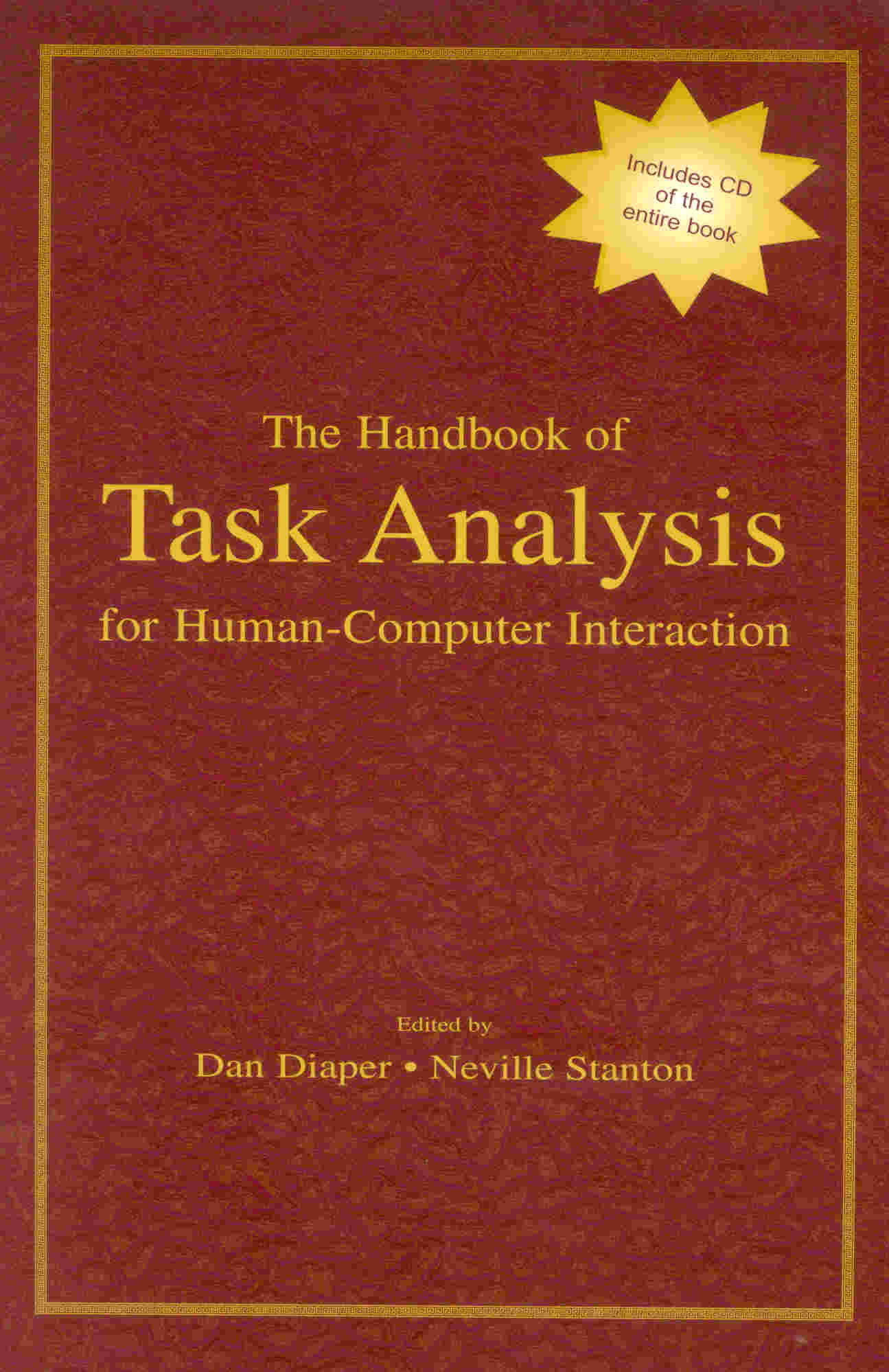
The most widely cited reference on task
analysis has been Task-Analysis
for Human-Computer Interaction ,edited
by Dan Diaper, who must take the main blame for
this new Handbook
of Task Analysis for Human-Computer Interaction ,as
his motive was in part to stem the trickle of
requests from around the world for chapters from
the out-of-print 1989 book. We, the editors,
wanted to produce the definitive reference on
task analysis for human-computer interaction (HCI).
In this we have failed, and the new handbook
provides merely a comprehensive sample
of the current research on and use of task
analysis.
In
Activity- Centered Design Geri Gay and
Helene Hembrooke argue that it is time to
develop new models for HCI design that support
not only research and development but also
investigations into the context and motivation
of user behavior. Gay and Hembrooke examine the
ongoing interaction of computer systems use,
design practice, and design evaluation, using
the concepts of activity theory and related
methods as a theoretical framework.
By
the author of The Design of Everyday Things, the
first book to make the connection between our
emotions and how we relate to ordinary
objects-from juicers to Jaguars. New research on
emotion and cognition has shown that attractive
things really do work better, a fact fans of Don
Norman's classic The Design of Everyday Things
cannot afford to ignore.
Cohen,
M. H., Giangola, J. P., Balogh , J. (2004). Voice
User Interface Design.
Addison-Wesley Professional. 368 pages.
Perhaps
the most critical factor in the success of any
automated speech recognition system, the design
of the voice user interface (VUI) often
determines whether the user experience will be
satisfying or frustrating. This practical guide
for industry professionals presents a method for
creating an effective VUI design. Sample topics
include creating a "persona" for the
interface, minimizing cognitive load, and
working with voice actors. The authors are
affiliated with Nuance Communications.
This book is a
guide to making usability a routine practice
within an enterprise, be it commercial or
government. Every organization has special
needs: There is no one simple approach that fits
all organizations. What this book provides,
however, is a solid methodology, not for
usability engineering (that's been done before
and exists in various forms), but for the part
that is truly missing--the institutionalization
of usability. This institutionalization
methodology is not new. It is simply a synthesis
of the best practices and insights from hundreds
of companies in the forefront of this
effort.